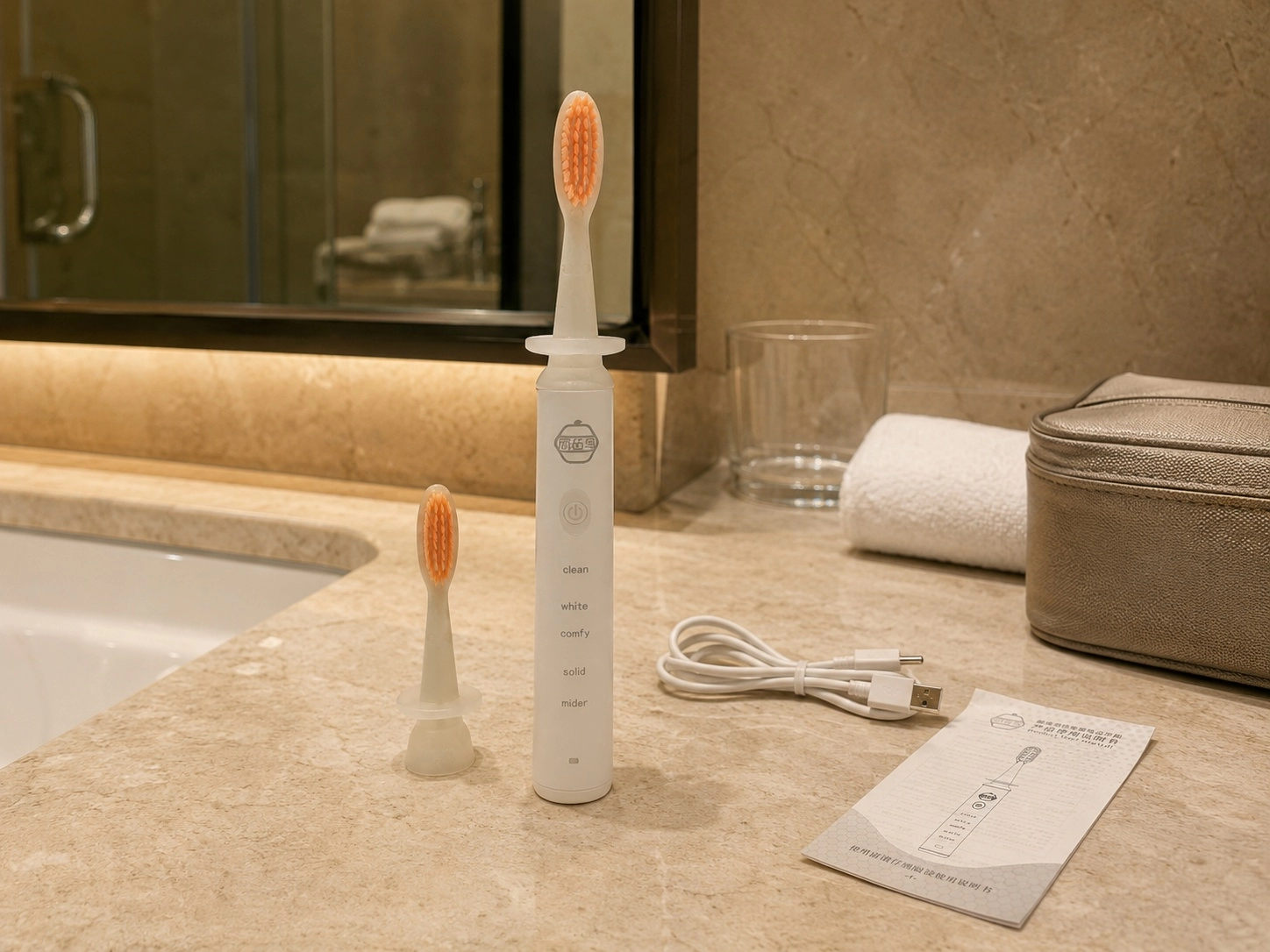
Quick answer: An electric toothbrush specification is only meaningful if it states how each number was measured. Vibration frequency quoted as a single figure (for example 31,000–38,000 vibrations per minute) is a range across intensity settings or across load conditions — ask which. Battery capacity in mAh says nothing about runtime without the drive power and duty cycle. IPX8 is a test class, not a durability guarantee, and it applies only if the seal survives repeated charging cycles. The four parameters that actually predict field performance are drive type, rated runtime under load, seal integrity after cycling, and whether the bristle-replacement reminder is time-based or condition-based.
The electric toothbrush category has an unusual property: nearly every specification on the box is technically true and practically uninformative. Vibration counts, mode counts and battery capacities are all measurable — but they are measured in ways that rarely correspond to how the product behaves in a bathroom over two years.
This article goes through the specification line by line and identifies what each number does and does not tell a buyer.
Drive type determines everything downstream
There are three drive architectures in common use, and they differ in more than price.
| Drive type | How it works | Characteristic behaviour | Maintenance implication |
|---|---|---|---|
| Sonic / magnetic suspension | Electromagnetic coil drives the shaft at high frequency with a mechanical suspension returning it | High frequency, low amplitude; cleaning action depends on fluid dynamics as much as mechanical contact | No wearing contact parts in the drive; seal and battery are the limiting components |
| Oscillating-rotating | Motor drives the head through a gear reduction to a reciprocating rotation | Lower frequency, larger amplitude; mechanical scrubbing dominates | Gear train and shaft seal are wearing items; noise tends to increase with age |
| Vibration (non-suspension) | Eccentric mass on a conventional motor | Lowest cost; frequency falls noticeably under load | Fewest parts; performance is the limitation rather than durability |
For a magnetic suspension sonic drive, the frequency specification is nearly always given as a band — 31,000 to 38,000 vibrations per minute, for example. That band represents something specific and it is worth knowing which: it is usually the range across selectable intensity levels, not a variation under load. If the figure is a load-varying range instead, the brush will feel weaker as the user presses harder, because pressing displaces the shaft against the suspension and reduces stroke.
This is why pressure response is a more useful question than peak frequency. Two brushes both rated at 38,000 vibrations per minute can deliver very different cleaning when the user brushes the way people actually brush.
Mode count is a marketing number; mode design is the real specification
Counting modes is easy — three intensity levels times five programmes equals fifteen, which is a legitimate arithmetic result and a poor basis for comparison.
The question that matters is what the modes change. A useful breakdown distinguishes:
- Amplitude or frequency changes, which alter the cleaning action itself
- Timing pattern changes, such as an extended gentle interval for sensitive gums, which alter the exposure profile
- Pure indicator changes, where the only difference is a light or a beep
A well-designed brush usually has fewer modes than a marketing sheet suggests, because modes that do not change the mechanical output are not modes. When reviewing a specification, ask for the drive setting behind each named mode. If two named modes map to the same drive setting, the count is inflated.
Battery, runtime and the charging interface
Battery capacity in mAh is a component specification, not a product specification. The number that a user experiences is runtime between charges, and runtime depends on drive power, the intensity setting used, and how the timer governs total brushing time.
Three points are worth confirming in writing:
- Runtime under load, at the highest intensity setting. Runtime measured at a low setting, or measured without the mechanical load of the shaft assembly, will not match user experience.
- Charging time and the charge interface. Inductive wireless charging removes exposed contacts and the corrosion they accumulate, at the cost of charging efficiency and a bulkier base. A DC cable remains the fallback in most designs, and having both is a practical choice for markets where the base may be lost.
- Charge management behaviour. Overcharge and over-discharge protection are stated as features on almost every product; the meaningful question is what the low-battery indication does — whether it warns at a usable remaining capacity or only shortly before shutdown.
For reference, a 1,200 mAh cell charging in about 15 hours is characteristic of a low-rate inductive charging design that prioritises seal integrity and cell longevity over charge speed. That is a defensible engineering position, but it should be presented to buyers as a deliberate trade-off rather than omitted.
What IPX8 does and does not mean
IPX8 indicates protection against continuous immersion under conditions specified by the manufacturer — unlike IPX7, which specifies 30 minutes at 1 metre. The critical phrase is conditions specified by the manufacturer. IPX8 ratings are not comparable between products unless the test conditions are disclosed.
Two practical consequences:
- The rating applies to a new, correctly assembled unit. It says nothing about the seal after 300 charge cycles, thermal cycling between a hot shower and a cold bathroom, or repeated flexing of the shaft seal. Seal degradation is the most common failure path in electric oral care, and it is not captured by an IPX8 mark.
- Charging contacts are usually the weak point. An inductive design eliminates the exposed contact entirely, which is why it is often paired with high immersion ratings. Where contacts exist, their corrosion resistance after repeated wet charging cycles is the question to ask about.
The bristle-replacement reminder: time-based or condition-based
This is a small feature that reveals a great deal about design intent.
A time-based reminder counts cycles or elapsed time and signals after a fixed interval, typically around three months. It is simple, cheap and predictable — but it is indifferent to how hard the user brushes, so it will under-warn a heavy brusher and over-warn a light one.
A condition-based reminder uses a property of the bristle itself. The fade-out bristle approach is a good example: tufts incorporate coloured filaments that lose colour progressively with use, so after roughly three months of normal brushing half or a third of the colour has faded and the cue to replace is visible on the head itself. This is self-calibrating to actual use and requires no electronics at all.
Both approaches are legitimate. The point for a buyer is that a reminder which does not survive contact with real usage is a liability rather than a feature — a brush that signals replacement too early trains the user to ignore the signal.
Testing that reveals the difference between units
Because most of the specification is not informative, the qualification of an electric oral care product has to rest on testing. Four tests carry most of the signal:
| Test | What it establishes | Accept criterion should state |
|---|---|---|
| Runtime under load | Actual usable brushing time per charge at the highest intensity setting | Duration and load condition, not only a rated figure |
| Charge cycle endurance | Runtime retention and seal integrity after repeated charge cycles | Number of cycles and the permitted runtime loss |
| Immersion after cycling | Whether the IPX8 claim survives aging rather than only applying when new | The test standard, immersion depth and duration, and the unit's prior history |
| Shaft seal flex endurance | Whether the moving seal between shaft and housing degrades under repeated displacement | Cycle count and a leakage or ingress criterion |
When these four are specified, an electric toothbrush can be compared on something other than its box. When they are not, the comparison is being made on the numbers that were easiest to print.
Frequently asked questions
Is a higher vibration count always better?
No. Frequency and amplitude trade against each other, and cleaning depends on both plus the bristle field. A high-frequency, low-amplitude drive cleans largely through fluid movement and requires the user to let the brush do the work; a lower-frequency, higher-amplitude drive relies more on mechanical contact. Higher numbers also tend to draw more power, which shortens runtime. The specification to compare is the combination, measured under load.
Why would a manufacturer choose slow inductive charging deliberately?
Because charge rate and seal integrity pull in opposite directions. Faster charging means higher current and often more generated heat, both of which stress the sealed enclosure and the cell. A low-rate inductive design avoids exposed contacts, runs cooler, and typically extends cell life — at the cost of overnight-only charging. That is a reasonable position for a product intended to sit in a wet environment for years.
Does IPX8 mean the brush can be used in the shower?
The rating indicates protection against continuous immersion under the manufacturer's specified conditions, which generally covers shower use. It does not mean the brush should be stored or charged while wet, and it is assessed on a new unit. Ask separately about seal performance after repeated charge cycles, because that is the condition under which real products fail.
How many brushing modes does a product actually need?
Fewer than most specifications list. Two or three drive settings that genuinely differ — a normal setting, a reduced-output sensitive setting — plus a timer behaviour cover the great majority of user needs. Modes that change only an indicator light add to the count without changing the brushing experience, and they increase the chance the user never learns the interface.
Are replaceable-head brushes worth specifying over disposable ones?
Economically for the user, yes — the handle and drive are the expensive part and they outlast the head by a wide margin. The engineering consequences are that the head-to-shaft interface becomes the critical mechanical joint, and its retention force and seal must survive repeated detachment. That interface should be endurance-tested specifically, since it is the component that distinguishes a good replaceable-head design from a mediocre one.
If you are evaluating an electric oral care programme, tell us your target market, channel and intended retail price band. We will respond with the drive, seal and battery configuration that fits, together with the test reports that support the specification — including load-conditioned runtime rather than rated figures alone.